
Kouri Island — A Nearly Circular Raised Coral Island
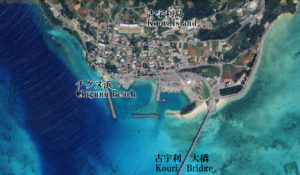
Kouri Island belongs to Nakijin Village and lies north of Yagaji Island in the northern part of Okinawa Main Island. It takes about 1.5 to 2 hours by car from Naha Airport to reach the island.
Kouri Island was formed over a long period of time as a coral reef slowly rose above sea level. Like many islands in Okinawa, the island is composed mainly of limestone, created from accumulated coral and shells.
When viewed from a distance, the island appears almost circular in shape. This form reflects its origin as a ring-shaped coral reef that developed around shallow tropical seas and was later uplifted gradually by geological movement.
Along the coast, you can observe marine terraces—step-like landforms created by repeated changes in sea level during past glacial and interglacial periods, combined with the slow uplift of the island itself. These terraces record the long natural history of the Ryukyu Islands.
On the northern shore, at Tinu Beach, two wave-eroded rocks form the famous “Heart Rock.” According to one interpretation, the name Kouri may be related to the Okinawan word “kui” (love), and the island is sometimes poetically called “Love Island.”
Kouri Bridge
Kouri Bridge connects Kouri Island in Nakijin Village with Yagaji Island in Nago City.
The bridge is 1,960 meters long and was opened on February 8, 2005. It is the second longest toll-free bridge in Okinawa Prefecture.
One of the reasons the view from Kouri Bridge is so beautiful is the white coral sand on the sea floor. In shallow water, sunlight is reflected and the longer wavelengths of red light are reduced, so the white sand appears emerald green or cobalt blue. This is a characteristic of healthy coral reef seas in tropical and subtropical regions.
Please note that the bridge may be closed to traffic during typhoons or severe weather for safety reasons.
The Adam and Eve of Okinawa
A Beginning Story from Kouri Island
There is a traditional story on Kouri Island about a boy and a girl who once descended from the heavens.
Long ago, it is said that these two children lived alone on the island. With no one else around, they lived freely, naked and innocent, surrounded by wind and sunlight.
Each day, the gods dropped rice cakes from the sky, and the two lived on this heavenly food.
One day, they decided to save some for the next day. From the moment this sense of possession appeared, the rice cakes stopped falling from the sky.
In order to survive, the boy and the girl began to work and live from the island’s nature, learning to support themselves.
Along the shore, they saw pairs of sea creatures—dugongs and seahorses—staying close together. From these living beings, they are said to have learned how a man and a woman come together.
In time, children were born to them. Their descendants increased, and the people of the Okinawa Islands are said to have come from these first ancestors.
On Kouri Island, this quiet story of beginnings is still remembered.
Oppawadake Forest Park
Oppawadake Forest Park spreads along the slopes of Mt. Otowa, which rises to 275 meters near the center of the Motobu Peninsula.
The park offers campsites, bungalows, and shower facilities, making it a comfortable place to relax and spend time in nature.
From the observation deck, you can enjoy a wide panoramic view where the villages of Nakijin, the deep green forests, and the blue sea come together in one sweeping landscape.
You can see evergreen forests and large tree ferns here, which are typical plants of Yanbaru’s subtropical forests, creating a quiet walking environment that reflects the original scenery of Yanbaru’s subtropical forests.